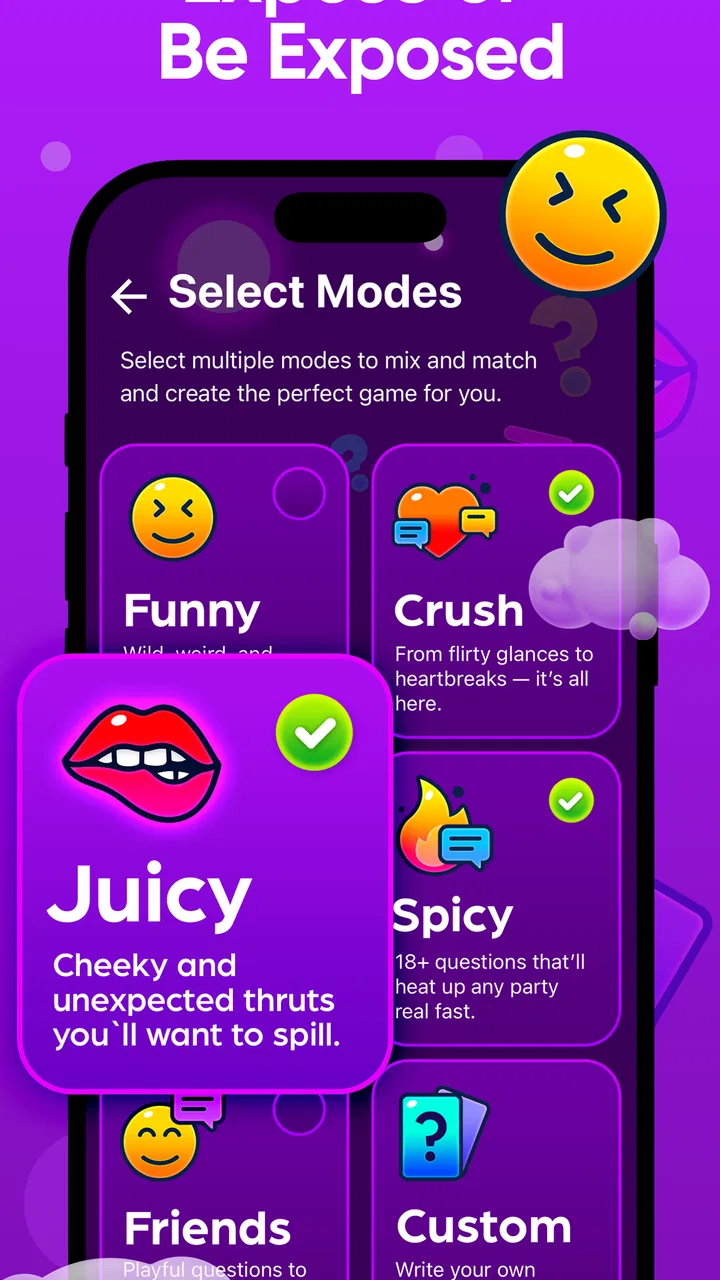
Exposed 2 - Guess who never?
- 4.7
- Rating
- 10.00K
- Installs
- Free
- Price

 Analysis by App-foxy
I tried Exposed 2 as the kind of party game you open when the room needs a quick spark rather than a complicated rulebook. It belongs to the trivia space, but it is less about proving who knows the most and more about seeing how well friends understand one another. The central idea is simple: prompts invite players to identify the person most likely connected to a statement, which can lead to laughter, teasing, and the occasional surprisingly accurate guess.
That simplicity is the main reason to consider it. You do not need to prepare a quiz, divide people into teams, or explain a long scoring system before starting. At the same time, the subject matter can become personal, so the quality of the session depends heavily on the group. In my experience, the best way to judge this game is not by asking whether it has the deepest trivia mechanics, but by asking whether your friends enjoy playful exposure and can handle a little awkwardness.
What to consider before choosing it
My first decision criterion is the group itself. Exposed 2 works best when everyone already has some comfort with one another. A group of close friends can turn a short prompt into an entertaining story, while a room full of strangers may hesitate or choose safe answers that drain the energy. It is also a better fit for people who enjoy conversation around the game instead of treating every round as a serious contest.
You May Also Like

 Pandora - Music & Podcasts
Pandora’s Music Is Easy to Start, but Harder to Recover
Pandora’s strength is its low-effort path from a seed to a station. Its weak spot is how much confidence it asks you to place in connection, setup, and quiet recovery.

 AccuWeather: Weather Radar
AccuWeather Review: A Quick, Clear Forecast for Everyday Decisions
For everyday plans, the best forecast is the one you can understand quickly. AccuWeather makes rain timing, radar, and local conditions easy to act on, with a few trade-offs.

 Hill Climb Racing
Why Hill Climb Racing Still Turns Crashes Into One More Run
A tiny car, a bumpy hill and one more upgrade: Hill Climb Racing keeps resurfacing because its simple chaos makes every near-miss feel personal.

 AliExpress - Shopping App
AliExpress Makes Global Shopping Feel Personal, but Shoppers Bear the Risk
AliExpress turns a global marketplace into a pocket-sized discovery engine. Its reach is useful, its shopping loop compelling, and its trade-offs easy to miss.

 Lords Mobile: Kingdom Wars
Lords Mobile Is a Kingdom-Building Routine, Not a Quick Match
A case-by-case verdict on the building, battles, device demands, and social commitments that make Lords Mobile rewarding for some players and exhausting for others.

 PDF Scanner app - TapScanner
TapScanner Makes Paperwork Easier to Capture, Check, and Share
TapScanner makes scanning with a phone feel less like a rescue operation and more like a dependable step in getting work done. Its capture tools are useful, though not flawless.
More From Our News Desk
View All News


The second criterion is the kind of entertainment you want. Traditional trivia apps reward memory, speed, and general knowledge. This game shifts the focus toward social reading. You are not mainly asking, “Who knows the answer?” You are asking, “Who in this room would do that?” That makes the experience more personal, but it also means the fun is less predictable than in a conventional quiz.
The third question is whether your group is comfortable with an age rating of Teen. That rating matters because prompts built around embarrassing habits, relationships, or bold opinions can land differently depending on who is playing. I would not treat it as a universal family game without first considering the ages and personalities at the table.
The game is free to start, which lowers the barrier for a casual gathering. It also includes optional purchases priced from $7.99 to $34.99 per item. I would make the decision to spend only after seeing whether the basic experience suits your group. A party game earns its place through repeated use, not through the promise of having more material sitting unused on a phone.
There is also a practical compatibility point. The current version is 1.8.0, and the game requires Android 8.1 or later. That is not a demanding requirement for many users, but it is worth checking before planning a group session around an older device. If the host’s phone cannot run it, the simplicity of the game does not help much.
How I would set up a real session
Picture a small gathering after dinner. Nobody wants to learn a board game, and conversation has started to slow down. I would place the phone where everyone can see it, agree that anyone may skip a prompt that feels too personal, and begin with the least sensitive questions. That small agreement changes the mood: people can be playful without feeling trapped by the format.
I would also avoid starting with the most outspoken person as the unofficial host. Rotate attention around the group so the game does not become a performance by one player. When a prompt produces a disagreement, let the players explain their choices rather than rushing immediately to the next one. The explanation is often more entertaining than the selection itself.
A useful tactic is to treat the game as a conversation starter rather than a complete evening’s entertainment. Play a few rounds, pause when a story develops, and return to it later if the group still wants more. This prevents the repeated prompt-and-answer rhythm from becoming tiring and gives the social side room to breathe.
Where Exposed 2 wins
The strongest part of Exposed 2 is its low setup cost. A normal trivia session may require someone to choose a quiz, manage answers, check correctness, and keep the pace moving. Here, the social knowledge already exists inside the group. The app supplies the trigger, while the players supply the context. That is a smart design choice for informal gatherings.
It also creates a different kind of suspense from ordinary trivia. In a general-knowledge game, suspense comes from uncertainty about the correct fact. In this format, suspense comes from wondering how the others see you. Even a familiar prompt can become interesting because the answer reveals the group’s shared impression of someone.
Another strength is its usefulness with mixed confidence levels. People who are not fast at factual quizzes can still participate fully because they are drawing on observation and memory of the group. Someone who rarely wins a standard trivia round may become the person who makes the most accurate social guesses. That gives the game a more balanced feel for gatherings where knowledge-based competition would leave some players quiet.
The title’s “guess who” premise also makes it easy to explain. I would not need to give a long demonstration before beginning. That is especially helpful when people are holding drinks, talking over one another, or joining the session at different times. The game can enter an evening without taking control of it.
Its audience size is another practical advantage, although I would keep the group manageable for conversation. With too many people, each prompt can take longer and individual players may feel less involved. With a compact group, guesses carry more meaning because everyone has enough shared history to support an opinion.
The public response suggests that the basic idea is connecting with its audience: Exposed 2 holds a 4.7 average from over 170 ratings and has passed 10 thousand installs. Those figures are not a guarantee that every group will enjoy it, but they do indicate that the concept has found an audience beyond a single novelty session.
Three ways to get more from the format
First, use a “soft start.” Before opening the game, tell everyone that the first few rounds are for learning the tone. This is more effective than beginning with a dramatic prompt and discovering too late that one player dislikes being singled out. The game becomes better when people understand that participation includes the freedom to keep boundaries.
Second, separate disagreement from accusation. If two players choose different people, ask what made each answer seem plausible. That turns a potentially uncomfortable moment into a comparison of perspectives. It also prevents the loudest player from deciding that a guess is automatically true just because it received more votes.
Third, use the app in short blocks during a broader social evening. I found that this type of game benefits from pauses. A long uninterrupted session can make the prompts feel repetitive, while a few rounds between food, conversation, or another activity keep the sense of discovery alive. This is a workflow advantage that is easy to miss if you judge it only as a standalone game.
There is a fourth useful habit: choose the host carefully. The person controlling the phone should keep the pace moving without interpreting every answer for the group. If the host becomes the judge, the game can feel controlled rather than spontaneous. A neutral host helps the app stay in its proper role as a prompt generator.
Where other options may fit better
Exposed 2 is not the right choice for every party. If your group wants factual competition, a conventional trivia game will probably be more satisfying. Those alternatives give players a clear standard for success, while this one depends on shared history and subjective judgment. Someone who prefers questions with definite answers may find the social format loose or unfair.
It may also be a poor fit for a newly formed group. When players do not know one another, guesses become guesses in the literal sense, with little personal evidence behind them. A general quiz can help strangers participate because knowledge is shared publicly; Exposed 2 asks for a level of familiarity that may not exist yet.
For families with younger children, I would choose a child-focused quiz or a lighter guessing game instead. The Teen content rating is a reminder that the tone is not automatically suitable for every age. Even when the players are mature enough, individual comfort still matters. A person who dislikes being the subject of jokes may feel exposed in a way that the title openly promises.
There is also a difference between social energy and competitive energy. If your friends enjoy keeping score, optimizing answers, and replaying rounds to improve, another trivia category may provide more lasting structure. Exposed 2 appears better suited to memorable reactions than to long-term mastery. Its replay value comes from changing groups, changing moods, and new conversations—not from perfecting a strategy.
People looking for a quiet solo experience should skip it. The game’s appeal depends on interaction, and playing without an engaged group removes the main reason to choose it over a standard quiz. Likewise, if your gathering is already noisy or tense, adding prompts that single people out may amplify the wrong atmosphere.
How it compares with familiar party choices
Compared with a standard trivia app, Exposed 2 is easier to start but less objective. Compared with a truth-or-dare style game, it can feel more structured because the prompt gives everyone a shared focus, yet it may still create personal moments. Compared with a board game, it needs less preparation and physical space, but it offers less strategic depth and fewer tangible components to keep people engaged.
That trade-off makes the choice fairly clear. Choose this game when the group is the content. Choose a knowledge quiz when the questions are supposed to be the content. Choose a more structured party title when you want teams, progression, or a defined winner to carry the evening.
Cost, purchases, and the cost of switching
The free entry point is useful because you can test the mood before committing money. I would install it shortly before a gathering, try a few rounds with people who already know the format, and decide whether it deserves a permanent place on the host’s phone. That approach is more sensible than buying optional content in advance for a group that may prefer another type of game.
The purchase range—from $7.99 to $34.99 per item—means the optional spending can move from a modest add-on to a much larger commitment. I would treat the higher end as something to consider only after repeated sessions. The right question is not whether additional material sounds attractive, but whether your group has already shown that it will return to the game.
There is a different kind of cost in switching away from it. If your friends enjoy the personal guessing format, replacing it with a factual quiz may reduce participation from people who are not confident with general knowledge. On the other hand, keeping it as the only party game can make the evening feel narrow if the same group wants new mechanics. My practical solution would be to keep it as a short social opener and use another game when the group wants a longer challenge.
Because the developer is MobiStack Digital and the game is still at version 1.8.0, I would pay attention to how comfortably it fits into your routine rather than assuming it must become the main game on your device. The current release is recent enough to feel like an actively relevant option, but a party game ultimately proves its value through the people who willingly ask to play again.
Questions I would answer before recommending it
Would I use it with close friends? Yes, especially when everyone can laugh at themselves and explain their choices without turning the round into a personal attack. Would I use it at a formal event or with unfamiliar coworkers? Only with considerable care, and probably not as the first activity. The social risk is higher when people do not yet know each other’s boundaries.
Does it replace a normal trivia game? No. It replaces the need for a prepared social icebreaker, not the need for factual questions. If your group is asking for history, science, entertainment, or sports knowledge, choose a quiz built around those subjects. If they want to see which friend best matches a playful description, this is the more natural fit.
Is it suitable for a quick break? That is where I think it performs particularly well. A few prompts can fill an awkward lull without requiring everyone to sit through a full campaign or learn a complex system. If the group wants an hour of uninterrupted progression, I would look elsewhere.
Should you pay for optional content immediately? I would not. Start free, observe whether the group engages, and spend only if the prompts are becoming a repeat part of your gatherings. The free starting point gives you enough room to make that decision based on actual use rather than anticipation.
What if someone dislikes a prompt? Establish a skip rule before playing. It keeps the mood friendly and avoids making one person negotiate their comfort in front of everyone. This is not a feature I would leave to chance; it is part of responsible hosting for a game built around personal impressions.
My recommendation
I recommend Exposed 2 to groups of friends who want a fast, conversation-led party game and who are comfortable being playfully singled out. Its best quality is not technical complexity; it is the way a simple prompt can uncover how people in the same room see one another. That makes it a useful choice for casual evenings, small gatherings, and short breaks between other activities.
I would skip it if you need objective scoring, a solo mode, a family-safe tone, or a strong strategic arc. A traditional trivia app will be better for knowledge contests, while a structured party game will suit groups that want teams and progression. Exposed 2 is more specific than those alternatives, and that specificity is both its appeal and its limitation.
Overall, I see it as a social tool rather than a complete evening program. Start with the free version, set boundaries, keep the rounds moving, and let the conversations matter as much as the guesses. If your friends enjoy that balance, this is a lively way to turn familiar personalities into the questions themselves. If they prefer clear answers and low personal exposure, choosing another trivia style will be the wiser decision.
FAQs for Exposed 2 - Guess who never?
01What is the main objective of Exposed 2 - Guess who never?
Exposed 2 - Guess who never? is a fun and interactive party game designed to reveal hilarious truths and secrets among friends. The objective is to answer questions or complete challenges that uncover who in the group is most likely to have done something or who never has. It's a great way to break the ice and deepen friendships.
02Is Exposed 2 suitable for all age groups?
The game is best suited for teens and adults due to the nature of some questions and challenges, which can be mature or personal. It's recommended to review the app's content rating and ensure it aligns with the players' age group and comfort level. It's always a good idea to customize the settings if playing with younger audiences.
03Do I need an internet connection to play Exposed 2?
Exposed 2 offers both online and offline modes. While an internet connection enhances the experience with updates and additional features, you can still enjoy the game offline with preloaded questions and challenges. This makes it perfect for parties or gatherings where Wi-Fi might not be available.
04Are there in-app purchases in Exposed 2?
Yes, Exposed 2 includes in-app purchases. These can unlock additional question packs, remove ads, or provide other enhanced features to enrich the gaming experience. It's advisable to check the in-app purchase options to avoid unexpected charges, especially if the app is accessible to minors.
05Can Exposed 2 be played with remote friends?
Absolutely! Exposed 2 offers a multiplayer mode that allows you to connect with friends remotely. You can invite friends to join your game session through a unique code or link, making it a versatile option for virtual parties and gatherings. This feature ensures that distance doesn’t hinder the fun.
Pros
- Engaging and fun gameplay.
- Easy to learn for new users.
- Multiplayer enhances interaction.
- Frequent updates keep it fresh.
- Minimal ads for a smooth experience.
Cons
- Limited offline functionality.
- Requires constant internet connection.
- In-app purchases can add up.
- Occasional connectivity issues.
- Some features need a subscription.

Exposed 2 - Guess who never?
Gallery